
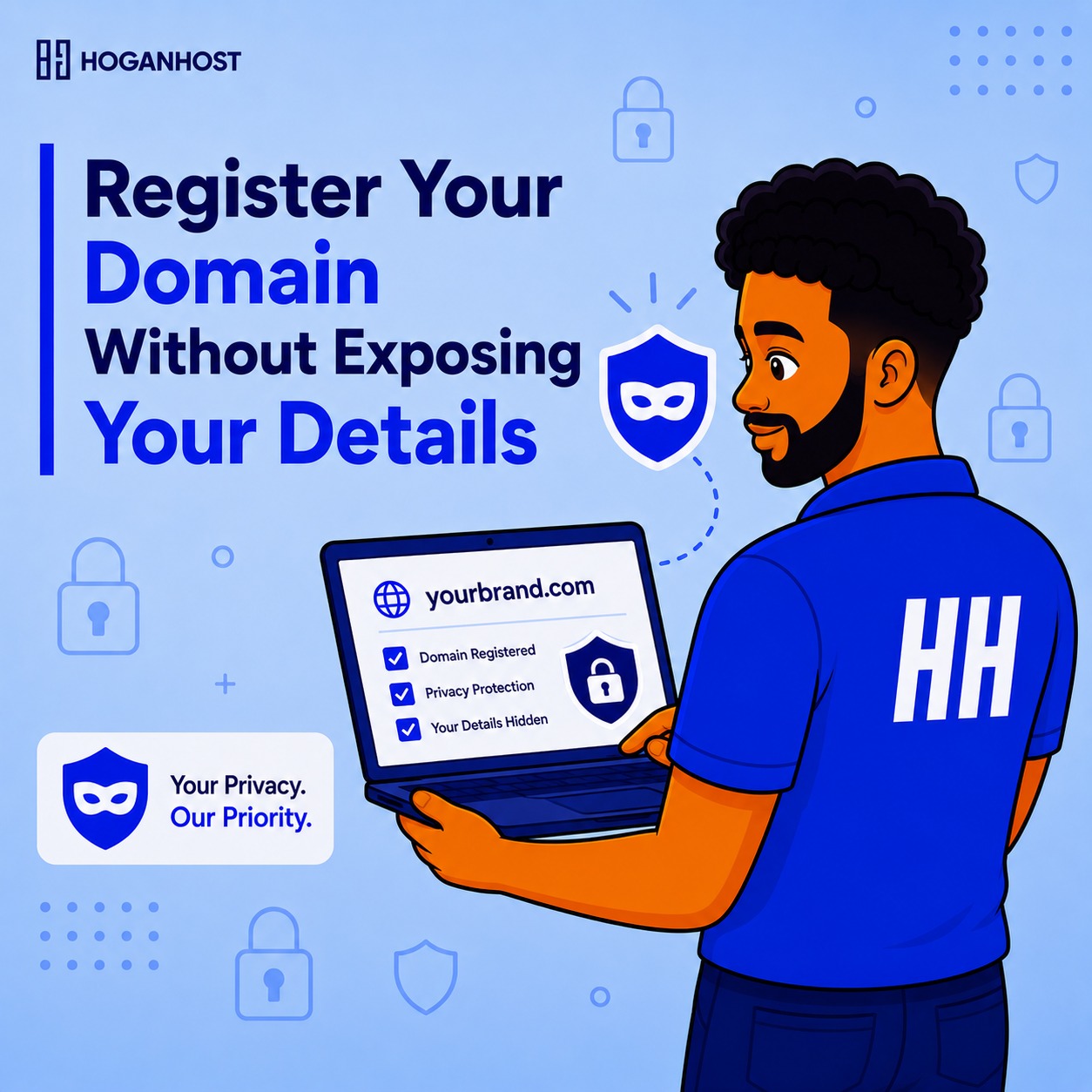
The moment a domain is registered, the owner’s name, address, email, and phone number have traditionally been published in a public database called WHOIS, visible to literally anyone who looks it up. For business owners who value privacy, or simply want to avoid an inbox flooded with spam the day after registration, that level of exposure feels unnecessary.
The good news is that domain privacy protection largely solves this, though the rules differ depending on which domain extension you choose. Here is what actually works in Nigeria today.
What WHOIS Privacy Actually Does
Domain privacy protection, sometimes called WHOIS privacy, replaces a registrant’s real contact details in the public WHOIS database with placeholder information, while forwarding any genuine inquiries sent to that placeholder email to the real owner. Spam, scraped marketing emails, and unsolicited solicitations get filtered out before they ever reach the actual registrant.
This does not make a domain completely untraceable, since registrars still hold the real ownership information internally and can be compelled to disclose it through proper legal channels. It simply removes casual public visibility of personal contact details.
The Situation for .com and International Extensions
For .com domains and most other international extensions, WHOIS privacy protection is widely available and often included free with registration through many registrars. This is the most straightforward path to anonymous registration for a Nigerian business that does not specifically need a .ng branded domain.
The Situation for .ng and .com.ng Domains
Nigeria’s domain registry recently changed its approach to this exact issue. As of mid 2025, the Nigeria Internet Registration Association, which manages the .ng namespace, began redacting WHOIS data by default across all .ng and .com.ng domain registrations. Registrant names, addresses, phone numbers, and emails now show as redacted in public WHOIS lookups automatically, without requiring a separate privacy add-on purchase.
This change was implemented specifically to align with Nigeria’s Data Protection Act, and it applies at the registry level rather than depending on an individual registrar’s optional privacy service. Legitimate inquiries, including from law enforcement through proper legal process, still have a structured path through the registrar, but casual public lookup no longer exposes personal details by default.
What This Means Practically for Business Owners
For a Nigerian business registering a .com.ng or .ng domain today, the privacy protection that previously required an extra purchase or manual setup is now largely automatic. Confirm with your registrar that this redaction is active on your specific registration, since implementation details can vary slightly by provider.
For businesses registering a .com domain instead, actively enable WHOIS privacy protection during checkout if it is not automatically included, since this extension does not carry the same registry-level default protection that .ng domains now have.
Balancing Privacy With Business Legitimacy
Complete anonymity is not always the right goal for a business domain. Customers, partners, and payment processors sometimes expect to verify that a business behind a website is legitimate and traceable, particularly for higher value transactions or B2B relationships.
A reasonable middle ground for many businesses is using a business address and dedicated business contact details rather than a home address and personal phone number, even without full WHOIS redaction, achieving meaningful privacy while maintaining professional credibility.
Registering With Privacy Built In
Choosing a registrar that handles privacy protection correctly and transparently from the start removes the guesswork around whether personal information is actually protected.
HoganHost’s domain registration service supports privacy-conscious registration across available extensions, helping Nigerian business owners register a domain without unnecessarily exposing personal contact information to the public internet.
Domain privacy has quietly gotten easier for Nigerian business owners recently, particularly for the .ng namespace, removing one more small barrier between deciding to register a domain and actually doing it with confidence.