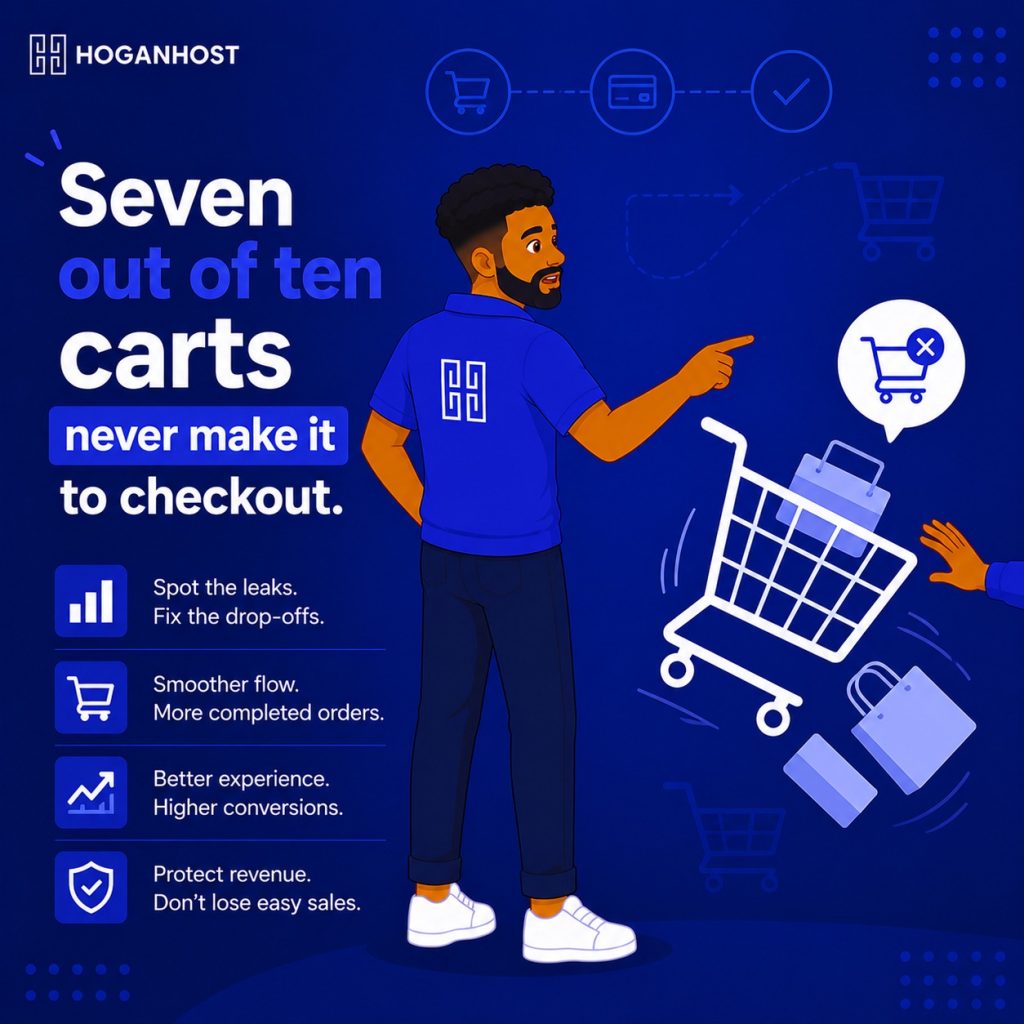
Roughly seven out of every ten shopping carts get abandoned before checkout completes, a figure that has held remarkably steady across ecommerce for over a decade despite constant improvements in technology. The good news is that a meaningful share of this abandonment is genuinely preventable, and fixing it is one of the highest-return improvements you can make to an existing online store.
Step 1: Understand Why Customers Are Actually Leaving
Not all cart abandonment is avoidable. A large share of shoppers add items simply to compare prices or save something for later, with no real intention of buying right away. But a significant portion is driven by specific, fixable friction points at checkout, and this is where your improvement effort should focus.
The most commonly cited reasons shoppers abandon a cart include unexpected extra costs revealed only at checkout, being forced to create an account before purchasing, an overly complicated checkout process, not trusting the site with payment details, and not being able to see the total cost upfront.
Step 2: Show The Full Cost Early, Not As A Surprise
Surprise costs at checkout, whether shipping fees, taxes, or other charges, are consistently the single biggest reason shoppers abandon a cart. Display your delivery charges and any additional fees as early as possible in the shopping process, ideally on the product page itself, rather than revealing them only at the final checkout step.
If your delivery cost varies by location, consider adding a simple delivery calculator earlier in the process, so customers know roughly what to expect before they invest time filling out checkout details.
Step 3: Offer A Guest Checkout Option
Forcing account creation before allowing a purchase remains one of the most common reasons shoppers walk away, particularly first-time customers who are not yet ready to commit to a full account relationship with your store. Offer a genuine guest checkout path, and let customers create an account afterward if they choose to, rather than making it a mandatory first step.
Step 4: Simplify Your Checkout Process
Every additional step, page, or form field in your checkout process gives a customer another opportunity to abandon. Review your current checkout flow and remove anything that is not genuinely necessary.
- Reduce the number of form fields to only what you truly need to complete the order.
- Combine steps where possible, rather than spreading checkout across many separate pages.
- Show a clear progress indicator if your checkout does require multiple steps, so customers know how much is left.
Step 5: Fix Mobile Checkout Specifically
Mobile cart abandonment rates run meaningfully higher than desktop, often by a significant margin, largely because mobile checkout flows tend to create more friction, smaller tap targets, more re-typing of payment details, and forms that are harder to fill out on a small screen. Test your actual checkout process on a real phone, and prioritize fixes here, since most of your traffic likely arrives on mobile in the first place.
Step 6: Offer Multiple Payment Methods
Limiting checkout to card payments alone costs real sales, particularly among Nigerian customers who often prefer bank transfer or USSD options. Offering the payment method a customer actually trusts and prefers removes a specific, common point of hesitation right at the final step of the purchase.
Step 7: Build Visible Trust Signals At Checkout
Customers who do not fully trust a site with their payment information will abandon regardless of how smooth the actual checkout mechanics are. Reinforce trust specifically at this critical step with a visible SSL padlock, recognizable payment method logos, and clear, honest information about your delivery and return policy.
Step 8: Send A Genuine, Helpful Cart Recovery Message
Not every abandoned cart is lost permanently. A well-timed follow-up message, whether email or WhatsApp, reminding a customer about items left in their cart can recover a meaningful share of these lost sales, particularly when the message is helpful rather than purely pushy, and makes it easy to simply return and complete the purchase.
Step 9: Test And Measure Your Actual Abandonment Rate
Use your store’s analytics to track your own actual cart abandonment rate over time, rather than assuming based on industry averages alone. Identify specifically where in your checkout process customers are dropping off most, since this reveals exactly which fix will have the biggest impact on your specific store.
Common Mistakes To Avoid
- Hiding delivery costs until the very last checkout step.
- Forcing account creation before allowing any purchase.
- Ignoring the specific friction points on mobile checkout, where abandonment tends to run highest.
- Never following up on abandoned carts, leaving genuinely recoverable sales unclaimed.
Cart abandonment will never reach zero, since some of it reflects normal browsing behavior rather than a fixable problem. But addressing the specific, well-documented friction points, hidden costs, forced accounts, and a clunky mobile checkout recovers a real, measurable share of sales that would otherwise walk away.
Want a store built with a fast, trustworthy checkout that keeps customers from abandoning? Get ecommerce-ready hosting from HoganHost and give your checkout the foundation it needs to actually convert.