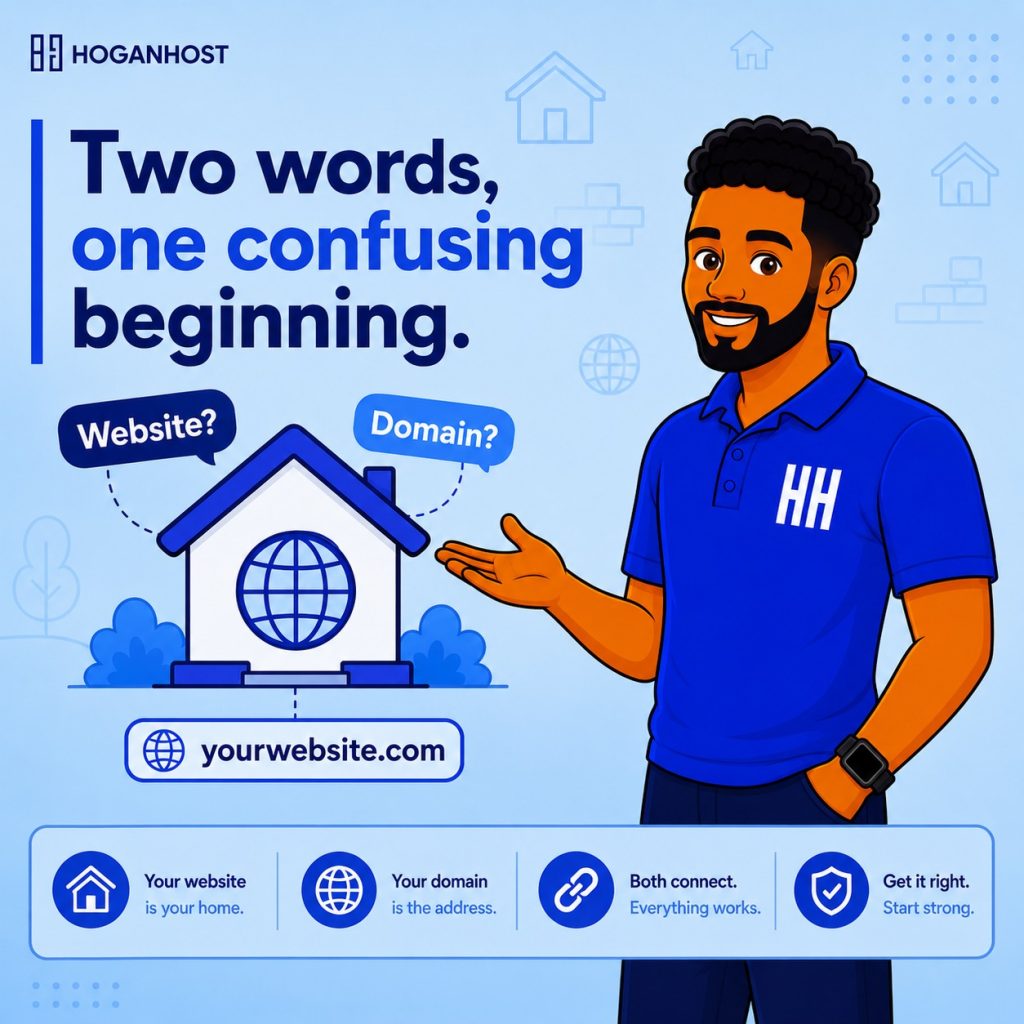
Hosting and domains get mentioned together so often that many beginners assume they are the same thing. They are not, and understanding the difference is the first real step toward building your own website confidently.
The Simplest Way To Understand The Difference
Think of your website like a physical shop. Your domain name is the shop’s address, the thing customers use to find you. Your hosting is the actual building, the physical space where your shop’s products, shelves, and everything else genuinely exists. You need both, and they work together, but they are two separate things you typically purchase separately.
What A Domain Name Actually Is
A domain name, like yourbusiness.com.ng, is the address people type into a browser to find your website. Without it, visitors would need to know a long, hard-to-remember string of numbers, called an IP address, to reach your site directly. A domain translates that technical address into something memorable and brandable.
Domain names are registered for a set period, typically renewed yearly, through a company called a registrar. You do not truly “own” a domain forever in the way you own physical property. You are essentially leasing the rights to that name for as long as you keep renewing it.
What Web Hosting Actually Is
Hosting is where your actual website files, images, text, code, everything a visitor sees, are stored on a physical server, a powerful computer built specifically to stay online and serve those files to anyone who visits your domain. Without hosting, your domain name would point to nowhere, since there would be no actual website content for it to display.
Hosting is paid for on an ongoing basis too, typically monthly or yearly, since the server needs continuous power, maintenance, and internet connectivity to keep your website accessible at all times.
How Domain And Hosting Actually Connect
Once you have both a domain and hosting, a behind-the-scenes system called DNS, short for Domain Name System, connects the two. DNS acts like a phonebook, telling the internet exactly which hosting server to direct visitors to whenever someone types your domain name.
This connection is typically set up by pointing your domain’s nameservers to your hosting provider, a simple, one-time configuration step most hosting providers walk you through clearly during setup.
Do You Need To Buy Domain And Hosting From The Same Company?
No, but it is often simpler if you do. You can register your domain with one company and host your website with a completely different one, connecting them through DNS settings. Many beginners find it easier to manage both through a single provider initially, since it reduces the number of separate accounts and logins to keep track of, though this is a preference rather than a technical requirement.
Common Types Of Hosting You Will Encounter
- Shared hosting, where your website shares server resources with other websites, kept affordable through this shared arrangement, and generally the right starting point for a new website
- VPS hosting, giving you a dedicated portion of a server’s resources, suited to a growing website needing more consistent performance
- Cloud hosting, offering flexible, scalable resources that adjust based on demand, suited to businesses with variable or unpredictable traffic
For a beginner just starting out, shared hosting almost always makes the most sense, both in cost and in simplicity of management.
Common Types Of Domain Extensions
The part after the dot in your domain, called the extension or TLD, carries some meaning too. .com remains the global default. .com.ng signals a Nigerian business specifically. .org typically suits non-profit organizations. Choosing the right extension depends on your specific business and audience, covered in more depth elsewhere, but the important beginner takeaway is that this choice is meaningful, not purely cosmetic.
A Simple Beginner’s Checklist To Get Started
- Decide on your business or website name.
- Search for domain availability across your preferred extensions.
- Register your chosen domain through a registrar.
- Choose a hosting plan matching your website’s actual needs.
- Point your domain to your hosting provider’s nameservers.
- Build your actual website on your new hosting account.
Common Beginner Confusions To Clear Up
- “I bought a domain, why isn’t my website live yet?” A domain alone does not include hosting. You need both, connected together, for a website to actually appear.
- “Do I need to renew hosting and domain separately?” Generally, yes, since they are typically billed as separate, ongoing services, even if purchased from the same provider.
- “Can I move my domain to a different host later?” Yes, this is a normal, straightforward process called pointing your domain to new nameservers or updating specific DNS records.
Understanding hosting and domains as two connected but distinct pieces removes much of the initial confusion around building your first website, and makes every subsequent decision considerably easier to navigate.
Ready to get both your domain and hosting sorted in one place? Register your domain and get hosting from HoganHost and take the guesswork out of getting started.